Printed Kurtas for Men – Because Plain Was Never the Only Option
There's a version of getting dressed for a celebration where you play it safe — solid color, minimal detail, nothing that draws too much attention. And then there's the printed kurta version, where the fabric itself does the talking. A good print on a well-cut kurta is one of the most effortless ways to look genuinely dressed up — no embroidery needed, no layering required, no accessories to fuss over. The print carries the outfit's entire weight.
India Has Always Been a Nation of Prints
Before digital printing, before screen printing, before any of the contemporary techniques that make today's printed kurtas possible — India was doing this with wooden blocks and natural dyes. The block-printed indigo fabrics of Rajasthan. The resist-dyed textiles of Gujarat. The Kalamkari hand-painted cloth of Andhra Pradesh. The batik traditions of Bengal. Indian textile culture has produced extraordinary printed fabrics for centuries, and the prints of today — however contemporary its design — sit within a long and genuinely rich lineage.
Knowing this doesn't change how a printed kurta looks on you. But it does change how it feels to wear one.
The Print Families Worth Knowing
Not all prints are the same — the type of print shapes the character of the garment entirely.
Block prints are the most artisanal — stamped onto fabric by hand using carved wooden blocks, they carry a slight irregularity that is part of their charm. Block-prints feel handcrafted and considered, and they connect directly to India's printing heritage. Available in geometric patterns, floral motifs, and traditional boteh designs.
Digital prints offer the widest creative range — any image, any color combination, any level of complexity can be translated onto fabric. Contemporary digital prints on kurtas include abstract compositions, photorealistic florals, geometric repeats, and cultural motifs rendered with a precision and vibrancy that traditional techniques cannot match.
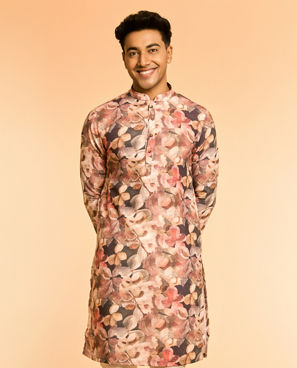
Floral prints cut across print techniques — they appear in block prints, digital prints, and screen prints alike. Florals on a kurta are perpetually in context at Indian celebrations — the connection between flowers and festivity runs deep, and a well-designed floral print always looks intentional.
Geometric and abstract prints suit men who want visual interest without the softness of florals. These prints create a more structured, contemporary aesthetic — particularly effective in two-color combinations on solid base colors.
Paisley and traditional motifs are the most culturally rooted print vocabulary — the boteh, the mango motif, the jaal pattern — these designs have been part of Indian fabric for centuries and continue to look entirely relevant on contemporary silhouettes.
Matching the Print to the Occasion
This is where most printed kurta decisions succeed or fail — not in the print itself, but in whether it fits the occasion.
Casual family gatherings and everyday occasions — small-scale prints, subtle geometrics, and muted color palettes in cotton.
Holi and Navratri — this is where bold prints earn their place. Large florals, vibrant multi-color digitals, and graphic geometrics in high-contrast colors. The more energy a print carries, the more it suits these occasions.
Mehndi functions — floral prints in warm tones — orange, coral, yellow, green — are natural mehndi choices. The print adds the festive color that the occasion calls for without requiring a solid jewel tone.
Eid — mid-scale prints in richer color combinations — deep blue and gold, teal and ivory, maroon and cream — suit Eid's balance of festivity and elegance. Avoid very casual or busy prints for Eid; choose something with a degree of composure.
College fests and cultural events — printed kurtas are essentially made for these occasions. Go bold, go colorful, go with a print that reflects your personality. This is the most personal category of dressing.
Wedding functions as a guest — a well-chosen printed kurta in a refined color palette and high-quality fabric is entirely appropriate for daytime weddings and pre-wedding celebrations. For evening functions, a print with gold or metallic elements elevates the garment into formal territory.
What the Base Color Does to a Print
The base color of a printed kurta shapes how the entire garment reads — and it's worth understanding before you choose.
White and ivory bases make prints feel fresh and light — every color in the print reads clearly, and the overall garment has a clean, contemporary quality. Good for summer occasions and daytime celebrations.
Black bases make prints dramatic and graphic — colors on black pop with a vibrancy that lighter bases can't achieve. The prints on a black base are a stronger visual statement than the same print on any other background.
Blue bases are the most heritage-connected — India's indigo printing traditions mean that blue-based prints carry a cultural depth that other color bases don't have. Blue also anchors multi-color prints naturally, preventing them from looking chaotic.
Earthy bases — olive, rust, sand, terracotta — suit block print and heritage motif prints particularly well. The earthy base and the artisanal technique reinforce each other in a way that feels genuinely cohesive.
Fabric Choices
Cotton is the most practical and widely used base — it holds print detail with exceptional clarity, colors appear vivid on its matte surface, and the fabric's stability makes it excellent for both block and digital printing. Most casual and semi-formal kurtas are cotton for good reason.
Linen and cotton-linen blends suit block prints and heritage motifs well — the fabric's natural texture adds to the artisanal quality of hand-stamped printing. These combinations feel grounded and considered.
Georgette and chiffon give kurtas a softer, more fluid character — the fabric drapes and moves gracefully, and prints on georgette have a painterly quality that works well for large-scale florals and abstract designs.
Chanderi and cotton-silk blends elevate kurtas into festive territory — the gentle sheen of these fabrics adds depth and luminosity to prints. The right choice when you want a kurta that holds its own at an occasion that calls for something more than plain cotton.
The Styling Rule
One rule, consistently applied: keep the bottom wear solid and neutral.
A printed kurta is the focal point of the outfit — it carries the visual interest, the colour, and the personality. The bottom wear's job is to support it without competition. White, ivory, cream, beige, and light grey churidars or trousers are the most effective partners for any print, regardless of print or color. Avoid patterned or heavily coloured bottoms alongside a printed top — the combination almost never works.
Beyond that, accessories should be minimal — a watch, a simple bracelet, and footwear appropriate to the occasion. The print is doing enough work. Let it.
FAQs
1. How do I know if a printed kurta is appropriate for a specific occasion?
The print scale and color palette are the two key indicators. Small-scale, muted prints in quality fabrics suit semi-formal and Eid occasions. Large-scale, vibrant prints are better for Holi, Navratri, and casual celebrations. For wedding functions, look for prints with some degree of refinement — a well-composed floral or a heritage motif in a rich color palette rather than a loud, busy pattern.
2. What is the difference between a block-printed and a digitally printed kurta?
Block printing is a hand-stamping process using carved wooden blocks and dye — it produces prints with a slight irregularity and a handcrafted quality that is part of its appeal. Digital printing uses inkjet technology to apply designs directly to fabric — it produces sharper, more complex, and more precisely colored prints. Block prints feel more artisanal; digital prints offer a more creative range.
3. Can a printed kurta be worn to a wedding?
Yes — particularly for daytime functions, pre-wedding celebrations, and mehndi or haldi ceremonies. Choose a print in a refined color palette on a quality fabric — chanderi or cotton-silk blend — for the most appropriate result. For evening wedding functions, a kurta with metallic elements or a more formal print design is a strong option.
4. What bottom wear works best with a bold, multi-colour printed kurta?
White or ivory churidars are the safest and most effective option — the clean, neutral bottom wear lets the print dominate without competition. Off-white and cream work equally well. Avoid any coloured or patterned bottoms alongside a busy print — the outfit will feel chaotic rather than confident.
5. How do I care for a printed kurta to prevent the print from fading?
Wash in cold water with a color-safe detergent. Turn inside out before washing to protect the printed surface from friction. Dry in shade — direct sunlight is the fastest route to a faded, dull print on any fabric. For block-prints, hand washing is preferable to machine washing to preserve the print's integrity and the fabric's texture over time.
Yellow Printed Kurta | White Printed Kurta | Red Printed Kurta | Green Printed Kurta | Grey Printed Kurta | Pink Printed Kurta | Beige Printed Kurta | Blue Printed Kurta

_18-04-2025-20-48:297-368)
_18-04-2025-20-48:297-368)
_18-04-2025-20-48:Swatch)
_18-04-2025-16-31:297-368)
_18-04-2025-16-31:297-368)
_18-04-2025-16-31:Swatch)
_18-04-2025-20-02:297-368)
_18-04-2025-20-03:297-368)
_18-04-2025-20-02:Swatch)
_18-04-2025-20-36:297-368)

_18-04-2025-23-30:297-368)
_18-04-2025-23-30:297-368)
_18-04-2025-23-30:Swatch)
_18-04-2025-22-40:297-368)
_18-04-2025-22-41:297-368)
_18-04-2025-22-40:Swatch)
_18-04-2025-18-18:Swatch)
_18-04-2025-17-46:297-368)
_18-04-2025-17-46:297-368)
_18-04-2025-17-46:Swatch)
_28-04-2025-07-17:297-368)
_18-04-2025-23-16:297-368)
_28-04-2025-07-17:Swatch)
_18-04-2025-19-42:297-368)
_18-04-2025-19-42:297-368)
_18-04-2025-19-42:Swatch)
_18-04-2025-17-37:297-368)
_18-04-2025-17-37:297-368)
_18-04-2025-17-37:Swatch)
_18-04-2025-20-55:297-368)
_18-04-2025-20-56:297-368)
_18-04-2025-20-55:Swatch)
_28-04-2025-07-19:297-368)
_18-04-2025-17-31:297-368)
_28-04-2025-07-19:Swatch)