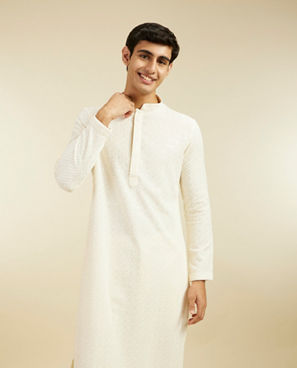
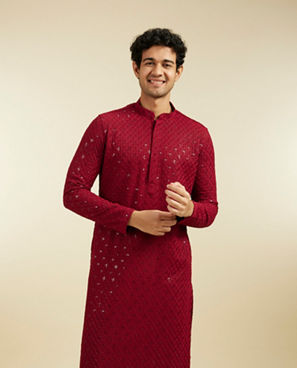
Lakhnavi Kurtas for Men – Three Centuries of Craft, One Remarkable Kurta
Some garments carry history lightly. The Lakhnavi kurta is one of them. Behind every piece of Chikankari embroidery — the white thread work that defines the Lakhnavi tradition — is a craft lineage that stretches back to the Mughal courts of Awadh, refined over three centuries in the narrow lanes of Lucknow's old city. And yet wearing a Lakhnavi kurta today feels entirely contemporary. The silhouettes are modern. The colors have expanded well beyond the traditional white-on-white. The occasions it suits cover the full range of what a modern Indian man dresses for. The craft is ancient. The kurta is for right now. At Diwas by Manyavar, the kurta collection brings this tradition into styles that are genuinely wearable — not preserved behind glass, but worn with pride at every celebration worth dressing for.
Lucknow and the Craft That Defined It
Lucknow's identity as a centre of craft and culture is inseparable from Chikankari. The tradition is believed to have been introduced or significantly developed during the reign of Nawab Asaf-ud-Daula in the late eighteenth century, though its roots reach further back. The Nawabs of Awadh were patrons of extraordinary refinement — their court culture produced music, poetry, cuisine, and clothing of a delicacy that became the defining character of Lucknow's cultural identity.
Chikankari embroidery was a central expression of this refinement. Originally worked in white thread on white muslin — fabric so fine it was called woven air — Chikankari was the embroidery of restraint and precision. No metallic threads, no sequins, no dense surface coverage. Instead: thirty-six distinct stitch types, each with its own name, technique, and visual character, worked with a patience and skill that took years to develop.
Today, Lucknow's Chikankari tradition supports tens of thousands of artisans — predominantly women working from their homes in the city's old quarters. Each kurta carries the work of their hands. That's worth knowing when you wear one.
The Thirty-Six Stitches — A Vocabulary Worth Learning
Most men who own a Lakhnavi kurta don't know what they're looking at when they examine the embroidery closely. Knowing the stitch vocabulary changes the experience of wearing one.
Tepchi — a long, running stitch that creates the flowing outlines of the pattern. The foundation of most Chikankari designs.
Bakhiya (shadow work) — stitched on the reverse of the fabric, creating a soft, diffused pattern visible from the front. On fine muslin, shadow work creates a dreamlike quality — pattern without color, visible only in certain light.
Jali — the fine mesh-like openwork that looks almost lace-like. Created by drawing threads together to form a net pattern, jali is among the most technically demanding and visually extraordinary of all Chikankari techniques.
Phanda — small, tight raised knots that fill the centres of floral motifs and add a tactile dimension to the surface.
Murri — a finer version of phanda, creating small seed-like raised dots in precise formations.
Khatao — a form of applied work where small shapes of fabric are cut and stitched onto the base to create additional surface texture.
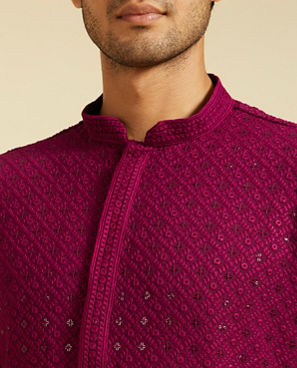
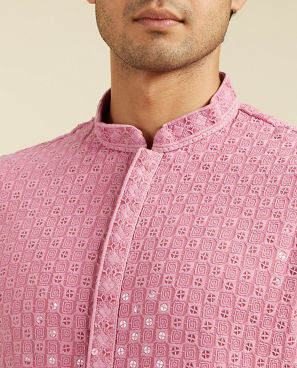
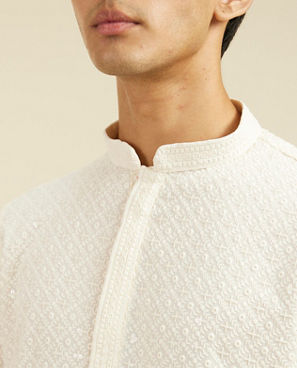
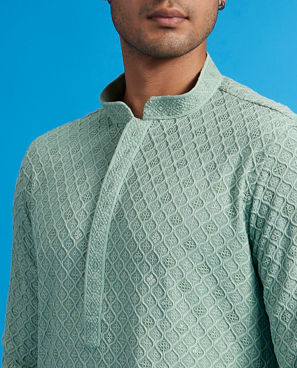
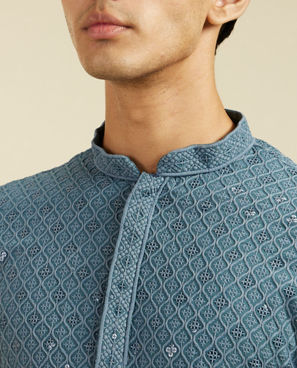
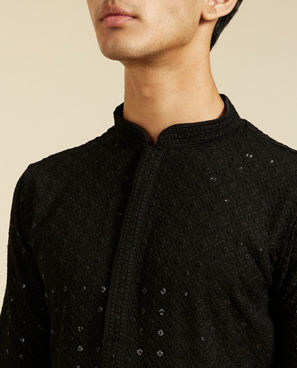
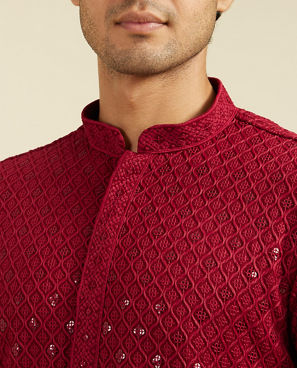
A well-made kurta doesn't use one technique — it combines several across the same garment, concentrating the most complex work at the neckline and placket where it will be most visible and most appreciated.
How the Lakhnavi Kurta Has Evolved
The traditional kurta was white thread on white or pale fabric — a study in monochromatic refinement. That version still exists, and it remains one of the most beautiful garments in Indian men's dressing. But it has expanded significantly beyond its origins. Contemporary Chikankari appears on a full range of base colors — and each one gives the embroidery a different character.
White and ivory bases honour the tradition most directly. The embroidery is visible through texture and shadow, revealing itself gradually in different light. The most formal and occasion-specific interpretation.
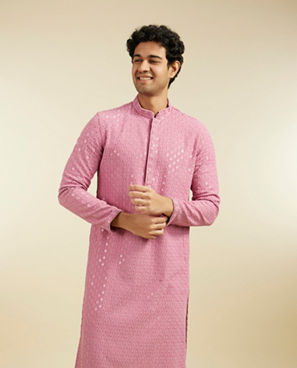
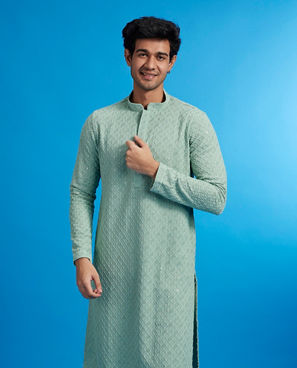
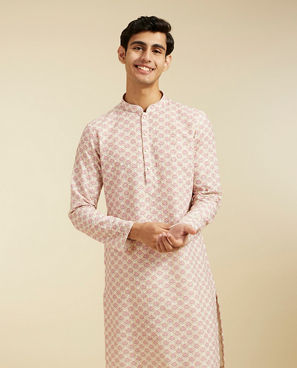
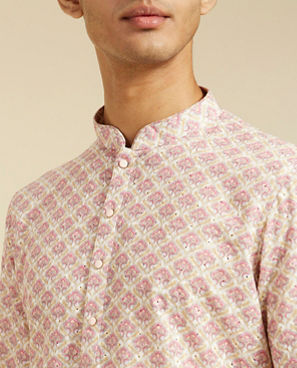
Pastel bases — blush, powder blue, mint, lavender — give Chikankari a fresh, contemporary feel. The white thread is more visible on these bases than on white fabric, making the embroidery more immediately legible while retaining its delicacy.
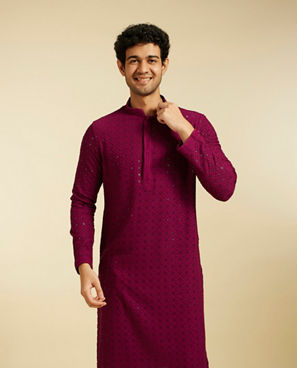
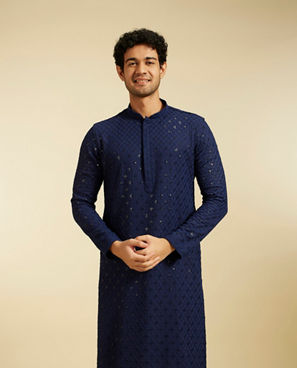
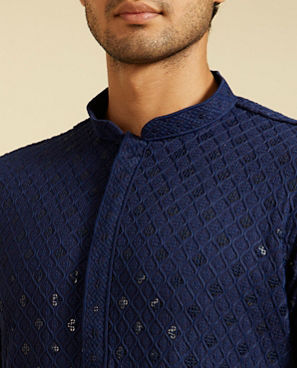
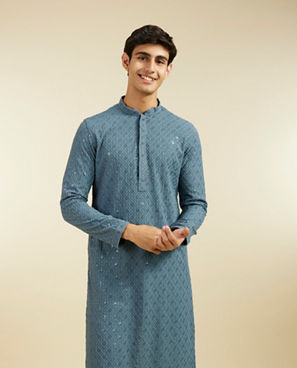
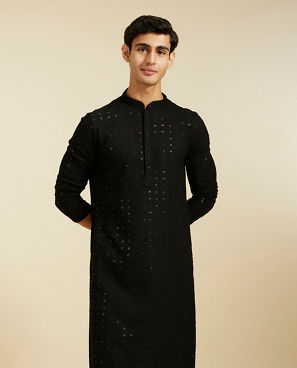
Deep color bases — navy, bottle green, maroon, black — create maximum contrast between the white thread and the fabric. The embroidery that whispers on white shouts on black. Same craft, entirely different visual character.
Cream and warm neutral bases — the warmth of the base gives the white thread a golden quality that white fabric doesn't produce. Particularly beautiful in natural and warm indoor light.
The Diwas kurta range covers several points across this color spectrum — ensuring the tradition speaks to every aesthetic, not just the purist one.
The Occasions it Gets Right
Eid is the kurta's most celebrated occasion — and white or cream Chikankari on Eid morning is practically a tradition in itself. The combination of the craft's refinement, the color's freshness, and the occasion's significance creates a look that requires nothing else. It is complete as it is.
Nikah ceremonies welcome the kurta with particular grace. The embroidery's delicacy and the silhouette's dignified refinement suit the spiritual significance of the occasion precisely. A white or ivory kurta at a nikah is among the most considered and culturally connected choices available.
Wedding functions as a guest — sangeet, mehndi, cocktail evenings — Chikankari on a pastel or deep base color suits each of these occasions with varying degrees of formality. A deep navy kurta at a sangeet, a blush one at a mehndi — the same craft, calibrated to the occasion through color and fabric.
Cultural events and literary gatherings — Lucknow's craft tradition is inseparable from its cultural identity, and wearing the kurta to events that celebrate Indian art, literature, and heritage carries a specific resonance. It's a choice that communicates cultural literacy as well as personal style.
Everyday semi-formal occasions — a lightweight cotton kurta in a pastel or neutral color is one of the most elegant casual options available. It looks more considered than a plain kurta and requires less effort than a formal embroidered one.
Fabric Is Fundamental to the Lakhnavi Experience
The base fabric of a Lakhnavi kurta is not just the background for the embroidery — it is half the garment's character.
Mulmul (muslin) is the most historically authentic base for Chikankari. The fabric's extraordinary fineness allows the embroidery to sit on it with a lightness that heavier fabrics cannot replicate. In white or cream, a mulmul kurta has an almost antique elegance — the same quality that made fine muslin the most prized fabric of the Mughal court.
Georgette is the most widely used contemporary base. Its fluid drape allows the embroidery to move gracefully with the fabric — the kurta flows rather than holds its shape, creating an elegant, relaxed silhouette. Georgette kurtas suit festive occasions where the fabric's movement adds to the overall visual impact.
Cotton provides a firmer, more structured base — the embroidery sits with greater precision and the silhouette holds its shape more cleanly. More appropriate for casual and semi-formal occasions than for formal festive settings.
Chanderi — silk-cotton blend — adds a gentle sheen that amplifies the Chikankari embroidery's depth in warm lighting. A kurta in chanderi has a luminosity that cotton and mulmul, for all their beauty, cannot match.
What the Styling Should and Shouldn't Do
The embroidery on a Lakhnavi kurta is the entire point of the garment. The styling should protect and highlight that point — not compete with it.
Solid, neutral churidars in ivory, white, or cream are the most appropriate pairing across all kurta colors. The bottom wear should be clean, pressed, and without visual distraction.
No Nehru jacket for casual and semi-formal occasions — the kurta is complete without layering, and a jacket often covers the neckline embroidery that is the garment's most intricate section. For formal evening functions where additional layering is appropriate, choose an ivory or tonal jacket that covers minimally and complements rather than dominates.
Footwear in neutral tones — embroidered juttis in white, ivory, or silver suit kurtas on white and pastel bases. Tan or caramel mojaris work for deeper base colors. Nothing heavy or statement-making.
Accessories minimal and in silver — a single bracelet or a clean watch. The embroidery is providing all the detail the outfit needs.
Caring
Chikankari embroidery is delicate — not fragile, but deserving of basic care that most fabrics don't require.
Hand wash in cold water with a gentle detergent. Never wring the fabric — press out excess water gently and dry flat in shade. Direct sunlight weakens the thread over time and yellows white fabric. Iron on the reverse side or with a thin pressing cloth over the embroidery — direct iron contact can flatten the raised stitches and damage jali work permanently. Store folded carefully or on a padded hanger, away from sharp objects that could snag the thread work.
With this basic care, a well-made kurta will last years and continue to look as beautiful as the day it was first worn.
Frequently Asked Questions (FAQs)
1. What is the difference between a Lakhnavi kurta and a Chikankari kurta?
They are the same thing described differently. Lakhnavi refers to the kurta's origin — Lucknow — while Chikankari refers to the specific embroidery technique that defines it. A Lakhnavi kurta is a kurta made in the Lucknow tradition using Chikankari embroidery. When brands use either term, they are referring to the same craft tradition and the same type of garment.
2. How do I identify genuine quality Chikankari embroidery?
Look for variety in stitch types — a well-made Lakhnavi kurta uses multiple techniques across the same garment rather than repeating a single stitch uniformly. Check the density — the embroidery should be concentrated at the neckline and placket, not uniform across the full surface. Look for jali work if present — the mesh should be even and precise. The thread should be smooth and consistent, with no loose ends or uneven tension visible on close inspection.
3. Can a Lakhnavi kurta be worn to a formal evening wedding function?
Yes — in georgette or chanderi on a deep base color, a Lakhnavi kurta is entirely appropriate for evening wedding functions. A navy or black Chikankari kurta where the white thread creates maximum contrast is a sophisticated and impressive evening wedding guest choice. Pair with ivory churidars and minimal accessories.
4. Is Chikankari embroidery always in white thread?
Traditionally yes — white thread on pale fabric is the defining characteristic of authentic Chikankari. Contemporary interpretations sometimes use thread colors that match or complement the base fabric for a tonal effect, or occasionally introduce a second thread color for decorative variation. The most respected and widely worn kurtas maintain the white thread tradition, though modern adaptations are increasingly accepted.
5. What makes the Lakhnavi kurta culturally significant beyond its appearance?
The Lakhnavi kurta represents one of India's most enduring artisan craft traditions — Chikankari directly employs tens of thousands of skilled embroiderers in Lucknow, the majority of them women. Wearing a kurta supports this living craft tradition and the communities built around it. Beyond the economics, the garment is a physical connection to a cultural heritage of refinement and artistic excellence that is genuinely worth preserving and celebrating.

_18-04-2025-20-30:297-368)
_18-04-2025-20-30:297-368)
_18-04-2025-20-30:Swatch)


_18-04-2025-22-57:297-368)
_18-04-2025-22-57:297-368)
_18-04-2025-22-57:Swatch)

_18-04-2025-21-15:297-368)
_28-04-2025-06-54:297-368)
_18-04-2025-21-15:Swatch)