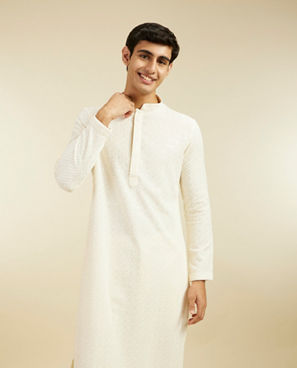
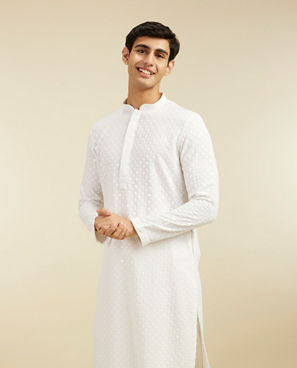
White Chikankari Kurtas for Men – The Original. Still the Best.
White Chikankari is where this craft began. Before the coloured bases, before the contemporary interpretations, before Chikankari became a pan-India fashion staple — there was white thread on white fabric, stitched by hand in the narrow lanes of Lucknow. That original combination has never needed an update.
White on White: Why the Original Combination Still Wins
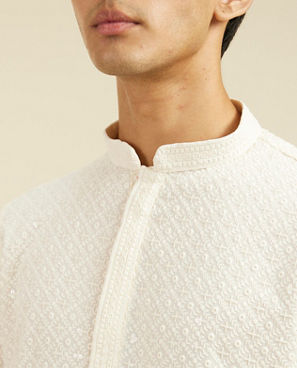
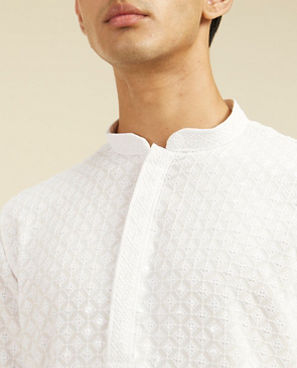
The defining characteristic of traditional Chikankari is that the embroidery is nearly invisible at first glance. White thread on white fabric means the design reveals itself through texture and shadow rather than color contrast. You see it when the light hits it. You feel it when you touch it. That subtlety is not a limitation — it is the entire point.
In a world of heavily embellished wear, a white Chikankari kurta stands apart precisely because it doesn't try to compete. The craft is there for anyone who looks closely enough — and those who do will always appreciate it more than something that announces itself loudly from across the room.
The Stitches Behind the Surface
A white Chikankari kurta is not just one type of embroidery — it is a collection of distinct techniques, each with its own character and placement logic. Knowing what to look for makes wearing one feel even more intentional.
Tepchi is a long, running stitch that creates flowing outlines — the foundation of most Chikankari patterns. Shadow work is stitched on the reverse of the fabric, creating a soft, diffused pattern visible from the front. On white fabric, it creates a dreamlike quality — pattern without colour. Jali is the fine mesh-like openwork stitch that looks almost lace-like. It's among the most difficult techniques in the Chikankari vocabulary and the most visually striking. Phanda creates small raised knots — typically used to fill the centres of floral motifs, adding dimension and texture. Murri is a fine, tight stitch that creates small seed-like raised dots — elegant, precise, and deeply traditional.
A well-made kurta typically combines several of these techniques across the same garment. The neckline and placket carry the densest embroidery; the body and sleeves carry lighter, more open patterns. Learning to read these techniques is part of what makes owning a Chikankari kurta genuinely rewarding.
When White Chikankari Is the Right Call
It works across more occasions than most men expect — and it often works best at occasions where other men have gone too heavy or too colorful.
Eid is its most celebrated occasion. This kurta on Eid morning is a classic for a reason — the combination of the color's freshness and the embroidery's craft creates a look that is clean, festive, and deeply appropriate for the occasion. It photographs beautifully in morning light.
Nikah ceremonies welcome it naturally — the color is respectful and dignified, and the embroidery adds the occasion-appropriate detail that a plain white kurta lacks.
Daytime wedding functions — particularly mehndi and haldi — are natural settings for this kurta. The color stands out against the warmer, more saturated outfits around it, and the embroidery's craft holds its own without competing.
Summer and spring festivals — Vishu, Poila Boishakh, and Gudi Padwa all welcome white. It is a considered, culturally appropriate choice for any of these occasions.
Casual and everyday wear — in lightweight cotton or mulmul, a simple kurta is one of the best everyday ethnic pieces you can own. Comfortable, easy to style, and always appropriate.
Choosing the Right Fabric
The fabric of the kurta significantly changes the garment's character and occasion-appropriateness. This is worth getting right.
Mulmul (muslin) is the most traditional base — ultra-fine, lightweight, and extraordinarily soft. The embroidery sits beautifully on this fabric, and the overall garment has an almost antique elegance. Ideal for summer and warm weather occasions.
Cotton gives a firmer, more structured silhouette. More practical for daily wear and active occasions. The embroidery reads cleanly against cotton's matte surface.
Georgette is the most fluid — the fabric drapes softly, giving the embroidery a graceful movement. A good choice for evening functions and occasions where you want the kurta to feel more elevated.
Chanderi adds a delicate sheen that gives white a slightly luminous quality — still understated, but with more occasion-appropriate richness than plain cotton.
Styling It Right
White Chikankari is one of the easiest kurtas to style — the colour and embroidery do the work, and the rest of the outfit just needs to support it cleanly.
White churidars for the most cohesive, traditional look — head-to-toe white with the Chikankari as the only surface detail is a powerful choice.
Ivory or cream churidars introduce a gentle tonal variation that keeps the look warm and grounded rather than stark.
Pastel trousers — soft blue, blush, or mint — work well for a contemporary casual look that still feels intentional and considered.
A white Nehru jacket over the kurta creates a layered tonal look that is particularly effective for formal festive occasions. Keep accessories minimal and in silver — a watch and a simple bracelet are enough. Let the embroidery be the detail.
Taking Care of Your Kurta
White fabric and delicate embroidery both require a little care — but it's not complicated.
Wash in cold water with a gentle detergent. Hand wash where possible — machine washing can stress the delicate stitching over time. Never wring the fabric; press out water gently and dry flat in shade. Direct sunlight will yellow white fabric over time, so always dry and store away from UV exposure.
Iron on reverse, or place a thin cloth over the embroidery before ironing to protect the raised stitches. Store folded carefully or on a hanger — keep away from coloured fabrics that could transfer dye onto the white base.
With basic care, a well-made white Chikankari kurta will stay crisp and beautiful for years.
What Makes a Good White Chikankari Kurta — A Buying Guide
Not all Chikankari kurtas are made equal. Here's what to look for when choosing one.
Density of embroidery — a well-made Chikankari kurta has embroidery concentrated at the neckline, placket, and cuffs, with lighter work across the body. Uniform, machine-like embroidery across the entire surface is a sign of lower quality.
Stitch variety — look for multiple stitch types within the same garment. A combination of shadow work, jali, and raised stitches like phanda indicates a more skilled and considered execution.
Fabric quality — the fabric should feel soft and have an even weave without pulls or inconsistencies. On mulmul and georgette, the drape should be fluid and the fabric should move easily.
Thread quality — the embroidery thread should be smooth, consistent, and tightly stitched. Loose threads or uneven tension indicate lower quality execution.
On Camera: It Has Its Own Magic
These kurtas have a photographic quality unlike anything else in men's wear. In natural light — particularly the clean, bright light of an Eid morning or a spring festival — white fabric glows with a freshness that no other colour replicates. The raised stitching of Chikankari catches that light and creates micro-shadows that make the embroidery visible and beautiful in photographs even when the thread and base are the same colour.
For portraits, white Chikankari creates a clean, strong frame that draws focus to the face. For group shots, the brightness of the white makes you immediately visible and well-defined in the frame. It's a colour and craft combination that consistently performs on camera — without needing any additional effort from the wearer.
Frequently Asked Questions (FAQs)
1. Is white Chikankari only for Eid, or can it be worn at other occasions?
It is one of the most versatile pieces in men's wear. Beyond Eid, it works beautifully for nikah ceremonies, daytime wedding functions, spring festivals, casual everyday wear, and semi-formal events. The combination of white's universality and Chikankari's craft makes it appropriate across a remarkably wide range of settings.
2. How is a white Chikankari kurta different from a plain white kurta?
The difference is entirely in the craft. A plain white kurta is a simple garment; It carries intricate hand embroidery across its surface — multiple stitch types, detailed motifs, and surface texture that reveals itself in light. The Chikankari embroidery is what makes the kurta festive and occasion-appropriate rather than simply casual.
3. Which fabric is best for a white Chikankari kurta in summer?
Mulmul and fine cotton are the best summer choices — both are lightweight, breathable, and comfortable in warm weather. Mulmul, in particular, has an extraordinary softness and fineness that make it ideal for Eid morning wear and spring festival occasions. Avoid heavier fabrics like georgette for outdoor summer events.
4. Can a white Chikankari kurta be worn to a wedding as a guest?
Yes, particularly for daytime functions like mehndi and haldi. For evening functions like the reception or sangeet, pair it with a Nehru jacket in ivory or a complementary tone, and choose a richer fabric like chanderi or georgette for added occasion-appropriateness. A well-styled kurta at a wedding is a memorable and genuinely elegant guest choice.
5. How do I keep my white Chikankari kurta from yellowing over time?
Wash in cold water with a detergent formulated for whites or delicates. Always dry in shade — direct sunlight is the primary cause of yellowing in white fabrics. Store away from coloured garments and in a cool, dry place. For long-term storage, wrap in acid-free tissue paper to prevent color transfer and fabric degradation.

_18-04-2025-21-15:297-368)
_28-04-2025-06-54:297-368)
_18-04-2025-21-15:Swatch)